
Money Management and Optimization Techniques for Private Wealth
High-net-worth individuals can protect capital by rebasing monetary holdings through expert fiat currency, monetary, and digital currency balancing optimization, to mitigate impact of ongoing global financial crisis - Discover proven techniques for preserving wealth.
Transitioning from multi-currency to monetary assets with rebasing services for protecting capital preservation power and preserving financial wealth... read more here...
Rebasing Monetary Holdings Management Service for HNWI Private Individuals
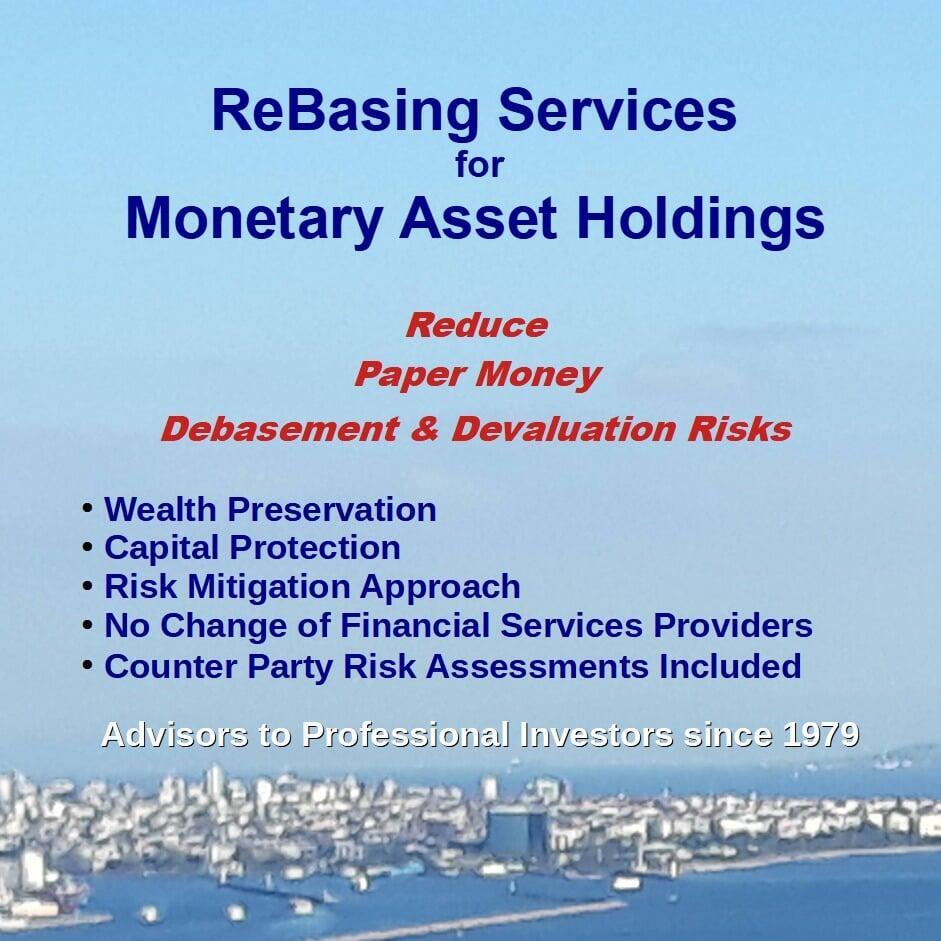
In an era of escalating financial volatility, High Net Worth Individuals (HNWI) face unprecedented challenges in safeguarding their liquid assets. Traditional bank deposits and fiat currencies, once viewed as safe havens, now carry hidden risks from inflation, systemic defaults, and counterparty failures. Rebasing monetary holdings—strategically restructuring and diversifying cash and near-cash assets—has emerged as a critical service for private individuals seeking capital preservation.
Drawing on expert analyses, this approach combines optimization techniques with forward-looking risk mitigation to shield wealth from the escalating financial turmoil.
The Relevance of a Silver Default Crisis to the Global Financial & Banking System and Capital Wealth Preservation
Generally it may appear frivolous and speculative to be discussing silver prices within the context of managing money holdings to protect capital purchasing power. This perception is mis-placed when considering more closely the relevance of silver prices to systemic stability and wealth preservation, and for the following reasons, is of core interest:
Inflation and purchasing power decline: Silver prices are reflecting long-term supply shortages that can not be remedied in the short or medium term. Silver price increases are representative of inflation risks across all monetary metals (gold, copper, nickel) and industrial metals (aluminum), strategic metals, and non-metal price increases including hydro-carbons/petro-chemicals, food chain prices, other industrial commodities. The price increases are now embedded into the future; the only question is when they are reflected into official price indices measuring inflation. These price increases arise largely from the supply shortages and price increases in hydrocarbons resulting from supply constraints in the Straits of Hormuz in Iran. Hydrocarbons are key inputs in industrial processing and production of metals and the commodity and finished goods supply chain in general. Silver prices (and gold) are representative of those inflationary pressures resulting in declining capital purchasing power and so serve as an effective hedge.
Contagion risk of contract default; The systemic stability of the global banking and financial system relies on trust in legal frameworks and contract enforcement. The contracts are paper, as are the futures contracts that are traded on exchanges to determine silver prices. The impending default in those contracts threatens trust in paper contracts in general, and a loss of trust would be contagious and a risk to systemic stability. This risk only appears to the general public at the time it is manifesting as reality, in other words, when it is too late to obtain insurance hedges against it occurring.
Rebasing protection: Rebasing the money assets in the portfolio of holdings after the decline in prices in precious metals and investment assets in general in early 2026 served the intended purpose of preserving purchasing power of those holdings. The increase in precious metals prices of 10% -15% over the following three months has resulted in a 3% increase in the overall purchasing power of the holdings portfolio, and thus serves the intended purpose of preserving purchasing power. In other words, maintaining a position in precious metals has insulated the money holding portfolio from a 3% decline in purchasing power for the most recent three month period, in contrast to the 3% decline in US Dollar purchasing power for all of 2025, measured by the US consumer price index (CPI), which itself does not fully reflect the decline in real capital purchasing power.
These are the reasons why the silver crisis is significant and important in the overall discussion of capital protection and wealth preservation. In other words, it is not an abstract concept with little practical relevance.
The Looming 2026 Financial Crisis and the Silver Default Imperative
The global monetary system is showing clear signs of strain, with price surges in precious metals like silver signaling deeper issues in fiat currencies, debt financing, and fractional reserve banking. A potential "silver default"—driven by extreme supply-demand imbalances and paper futures contract failures—could trigger contagion across financial markets, leading to bifurcated price discovery where physical assets soar while paper instruments collapse.
Analysts warn of 15-30% inflationary devaluation in major fiat currencies over the next two years, exacerbated by fiscal indiscipline in economies like the US, EU, Japan, and China. History shows repeated boom-bust cycles: new debt issuance fuels misallocation, followed by credit crises, emergency liquidity, and eventual currency erosion. Resource-backed currencies (e.g., NOK, AUD, CAD) offer relative resilience due to export revenues, while digital assets like BTC, ETH, and regulated stablecoins (e.g., Tether’s USTA) provide transactional superiority.
Managing these same risks for 35 years in Turkiye’s highly volatile, high inflation, rapid currency debasement financial markets, has provided ample experience and methodological discipline to achieve consistent results managing the same risks as they escalate across the world’s financial system. Instead of emerging markets like Turkiye converging towards greater stability experienced in developed economies, the reverse is occurring: developed economies are converging towards the increased volatility and shorterenijng durations of credit cycles, driven by fiscal & budgetary disregard of politicians. As the interest burden of US debt repayments crosses the threshold of repayment hopelessness, the outcome is inevitable. History shows this in every example without exception. The solution is to apply strategic & tactical ReBasing of Money Holdings in an ongoing process designed to protect the capital purchasing power of wealth.
Counterparty Risk Assessments: The Foundation of Safe Monetary Management
Counterparty risk—the danger that banks, custodians, or financial institutions fail to meet obligations—has become central to monetary holdings. Bank deposits, once considered risk-free, now function like equity investments in some jurisdictions, exposing holders to insolvency losses or funding calls. Crypto custody adds layers of treasury and exchange risks, while even monetary metals carry dangers if held in dematerialized or poorly secured forms
Effective assessment requires rigorous due diligence: reviewing jurisdictional regulations, counterparty balance sheets, and custodial terms. Prefer brokerage accounts over traditional banks for narrower risk exposure, and insist on physical possession of metals to eliminate counterparty dependency. Gradual re-basing over 12-36 months—shifting from high-risk fiat into diversified holdings—minimizes volatility while capitalizing on current dollar strength.
HNWI benefit enormously from this disciplined process. A balanced portfolio reduces short-term swings and long-term devaluation, stabilizing capital in crisis environments. Professional services guide clients through account openings, provider evaluations, and ongoing monitoring, ensuring compliance and liquidity without triggering unnecessary tax events.
Cash Management and Optimization Techniques for Private Wealth
Government cash management practices offer powerful lessons for HNWI. Centralized structures analogous to Treasury Single Accounts (TSAs) consolidate fragmented holdings, minimize idle balances, and maximize returns on surpluses. Accurate cash-flow forecasting—daily, weekly, or monthly—prevents mismatches, while short-term instruments like treasury bills, repos, and term deposits bridge gaps without excessive borrowing costs.
The 2022 PEMNA report on cash management in Korea and South Africa highlights proven methods: setting minimum/maximum balance targets, integrating forecasting with investment decisions, and diversifying across approved counterparties under strict credit limits. Korea’s dBrain system and South Africa’s daily sweeping demonstrate how real-time monitoring and coordination slash opportunity costs—idle cash in unremunerated accounts can be “particularly costly.”
Post-COVID adaptations, including flexible buffers and bond-switch programs, underscore agility. For private individuals, these translate to portfolio-wide optimization: sweeping excess cash into remunerated instruments, maintaining liquidity buffers, and aligning monetary holdings with personal cash-flow needs. The result? Lower operational risks, reduced refinancing exposure, and higher net returns on liquid assets.
Implementing a Money Rebasing Strategy: Practical Steps Forward for Individuals
Rebasing begins with a comprehensive audit of current holdings, followed by counterparty assessments and phased diversification. Prioritize physical monetary metals for zero-counterparty security, blend in defensive fiat currencies and regulated digital assets, and apply TSA-style consolidation for efficiency. Professional guidance ensures seamless execution within existing banking relationships or through specialized programs.
Services dedicated to monetary holdings management provide research-backed tools, performance reporting, and weekly updates—far beyond generic financial advice. By acting now, HNWI avoid the pitfalls of waiting: nothing is gained by delay in a rapidly deteriorating monetary environment.
In conclusion, rebasing monetary holdings is essential proactive stewardship. By integrating crisis foresight, rigorous risk assessment, and optimization best practices, HNWI can preserve and enhance capital resilience. Consult specialized providers today to secure your monetary base against tomorrow’s uncertainties.